
Search Arkansas Arrest Records
Arkansas arrest records are kept by sheriff's offices, city police, and the Arkansas State Police. You can look up jail rosters, active warrants, and booking photos online for many counties. The state also runs the ARCH system for a full criminal history search by name and date of birth. Most arrest records are open to the public. This page shows you where to search, what each database holds, what it costs, and which office to call when you need a copy of an arrest report or booking file.
Arkansas Arrest Records at a Glance
Where to Find Arkansas Arrest Records
Arrest records in Arkansas live in several places. The arresting agency keeps the original report. That's the county sheriff, a city police force, or a state trooper. The county jail holds booking data: mugshot, charges, bond, and the day you were booked in. The Arkansas Crime Information Center, or ACIC, is the state clearinghouse for criminal history. Courts keep case files once charges get filed. So the answer to "where do I look" depends on what stage of the process you care about.
ACIC sits at 322 S. Main Street, Suite 615, Little Rock, AR 72201 and handles the statewide data system that links more than 250 criminal justice offices. The phone is 501-682-2222. Most ACIC data is restricted to law enforcement and is exempt from FOIA. The public side of ACIC runs through ARCH at arch.ark.org and the sex offender registry at ark.org/offender-search. For help with court-level case data, the Administrative Office of the Courts at arcourts.gov runs CourtConnect.
The Arkansas State Police Identification Bureau handles manual requests from the public. Address: 1 State Police Plaza Dr., Little Rock, AR 72209. Phone: 501-618-8500. Hours run from 7:30 AM to 5 PM. The bureau notes that 100% of its arrest records are fingerprint supported, which makes them far more reliable than name-only data. For mailed requests, use form ASP-122 with a $25 fee. Many county sheriff sites also link back to ARCH and the ACIC registry when the public asks for a broader check.
Note: Open investigation files and sealed arrest records are not public. Everything else typically falls under the Arkansas FOIA at arkansasag.gov.
Arkansas Criminal History (ARCH) System
ARCH is the main public path to a statewide arrest and conviction check. It was created by Act 1185 of 2015, codified at Ark. Code Ann. § 12-12-1501 et seq. The system pulls from the ACIC database and returns results tied to fingerprints, not just name matches. The Arkansas State Police Identification Bureau maintains the records it searches. A screenshot of the front page of the system sits below, and you can launch a search from arch.ark.org.
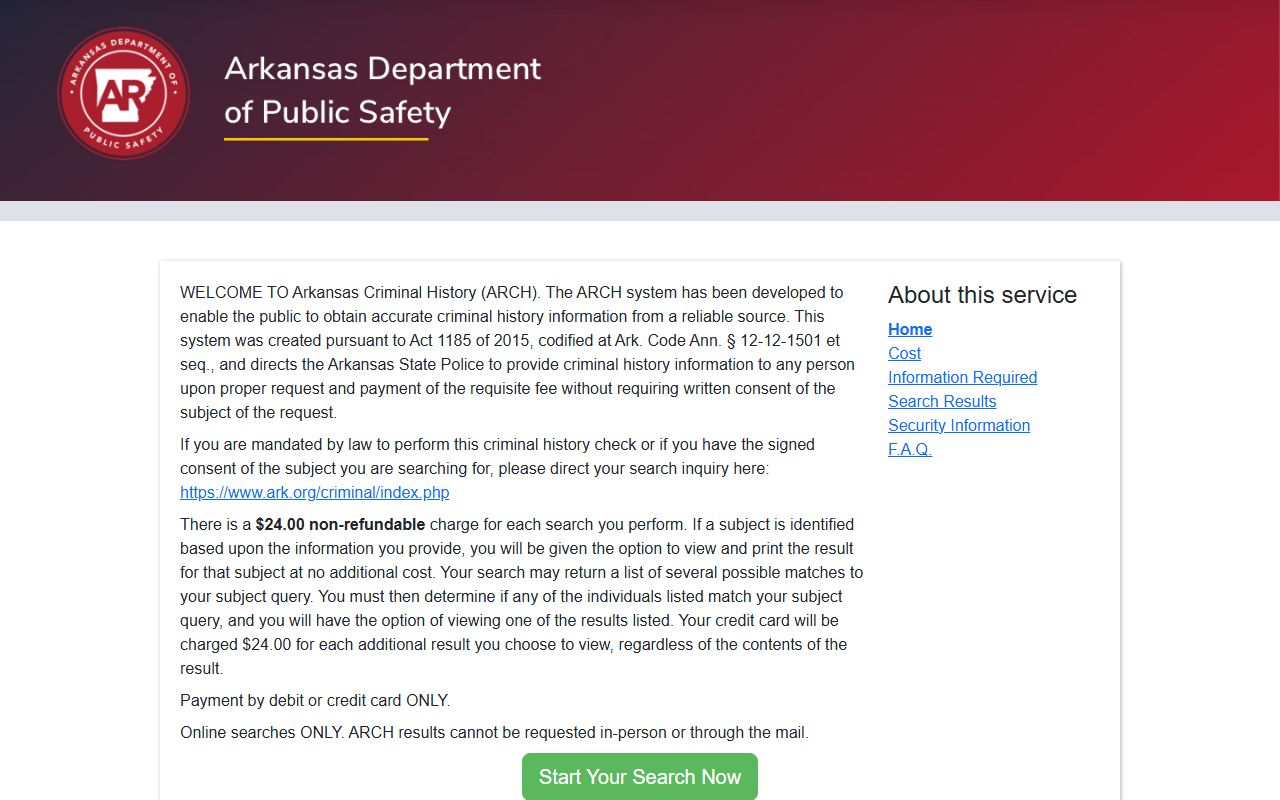
The ARCH search costs $24.00 per run. That breaks down to a $20 search, a $2 processing fee from the Information Network of Arkansas, and a $2 credit card fee. Results are non-refundable. You need the subject's first and last name, sex, and date of birth. ARCH returns one of three outcomes: subject identified with a history, subject identified with no history, or no subject identified at all. Common names like John Smith may throw several hits, so race or ZIP can help narrow things.
ARCH contains Arkansas felony and misdemeanor convictions, open felony arrests less than three years old, and sex offender status for levels 1 through 4. It does not contain juvenile records, dismissed charges, unresolved misdemeanor arrests, felony arrests older than three years, not guilty findings, active warrants, sealed records, pardoned convictions, out-of-state history, federal history, traffic arrests, or arrests made without fingerprints. Certified results for immigration or adoption are not issued through ARCH. For those, you need the in-person or mail channel.
Under Ark. Code Ann. § 12-12-1013, any person has the right to see and challenge their own criminal history record in ACIC. Requests go to the Administrator of the ACIC Criminal History Division or the desk at 501-682-2222. The $24 ARCH fee is allocated by the General Assembly to support the state's criminal justice information systems and the Crime Victims Reparations Revolving Fund.
Online Criminal Background Check for Arkansas
The Online Criminal Background Check System, or CBC, is different from ARCH. CBC is not for the general public. It's for employers, schools, and licensing bodies that have a signed, notarized release from the subject. The CBC portal is run by the Arkansas State Police. You need an Information Network of Arkansas account to use it.
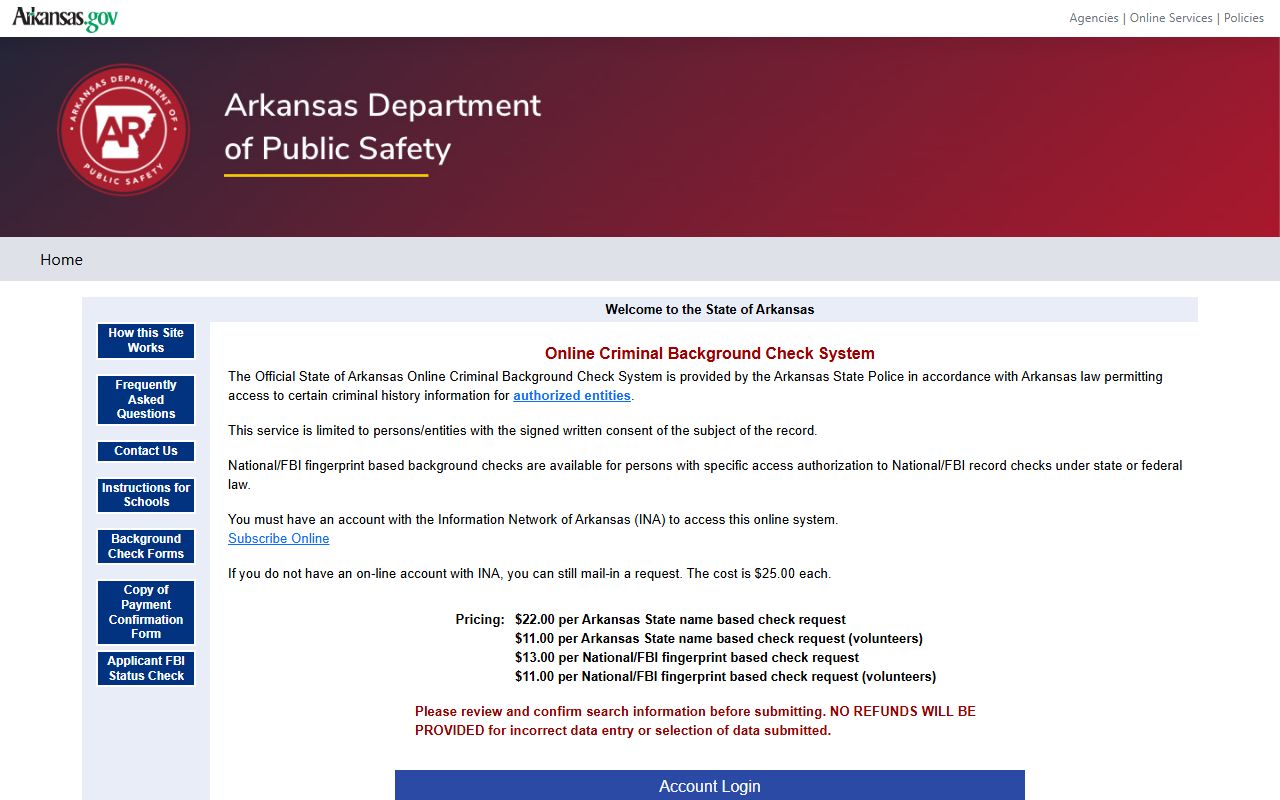
CBC pricing runs $22.00 per state name-based check, or $11.00 for volunteer organizations. National FBI fingerprint-based checks cost $13.00, or $11.00 for volunteers. Mail-in requests without an INA account cost $25.00 each. No refunds are given for wrong data entry. The system releases felony and misdemeanor convictions, pending felony arrests in the last five years, and sex offender status. Processing through the Identification Bureau takes two to five business days plus mail time.
Using CBC for any purpose other than what was stated in the request is a Class A misdemeanor. The State Police retrieves data from ACIC, which ties records together by fingerprint. That matters because a pure name search can miss people who use aliases. If a subject sees an arrest or conviction they think is wrong, they can challenge the record at no cost through ACIC.
Searching Arkansas Arrest Records on CourtConnect
CourtConnect is the public face of court case data. It runs on the Contexte case management platform. The Administrative Office of the Courts keeps it going. You can search for people, businesses, case types, judgments, recent case filings, and citation numbers. There is no fee. The URL is caseinfo.arcourts.gov.
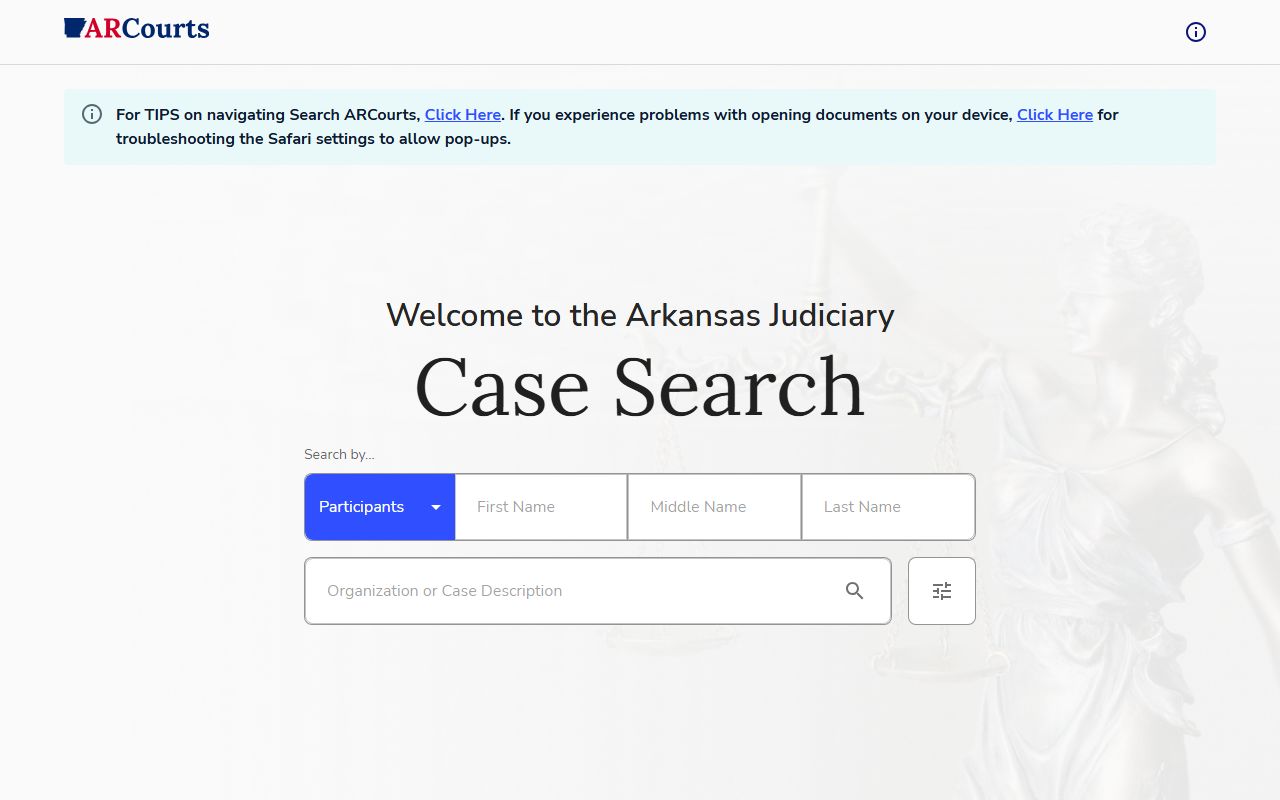
Not every county is on CourtConnect yet. Some counties post full data. Others post partial. The Research shows most large counties are in and a long list of rural counties still come up thin. Scheduled maintenance hits Monday through Friday 12:30 AM to 2 AM and Saturday 10 PM through Sunday noon. For help with AOC Public CourtConnect, email acap.help@arcourts.gov. The Administrative Office is at 625 Marshall Street, Little Rock, AR 72201, 501-682-9400, Director Marty Sullivan.
CourtConnect covers criminal, civil, domestic relations, probate, and traffic case types. That makes it useful for tracking what happens after someone is arrested in Arkansas. The arrest itself may not appear. The charging document, the docket, and the final disposition will. A sister site, eTraffic, lets the public pay traffic tickets online.
Note: CourtConnect shows case activity after charges are filed. For the booking record itself, go to the sheriff's jail roster in the county where the arrest happened.
Arkansas Inmate Search and Custody Lookups
When someone is sent to state prison, the Arkansas Department of Corrections runs the search tool. The ADC Inmate Search covers state-run prisons and most county jails statewide. You can search by ADC number, name, gender, age, race, county, facility, or offense category. Use of the tool is free.
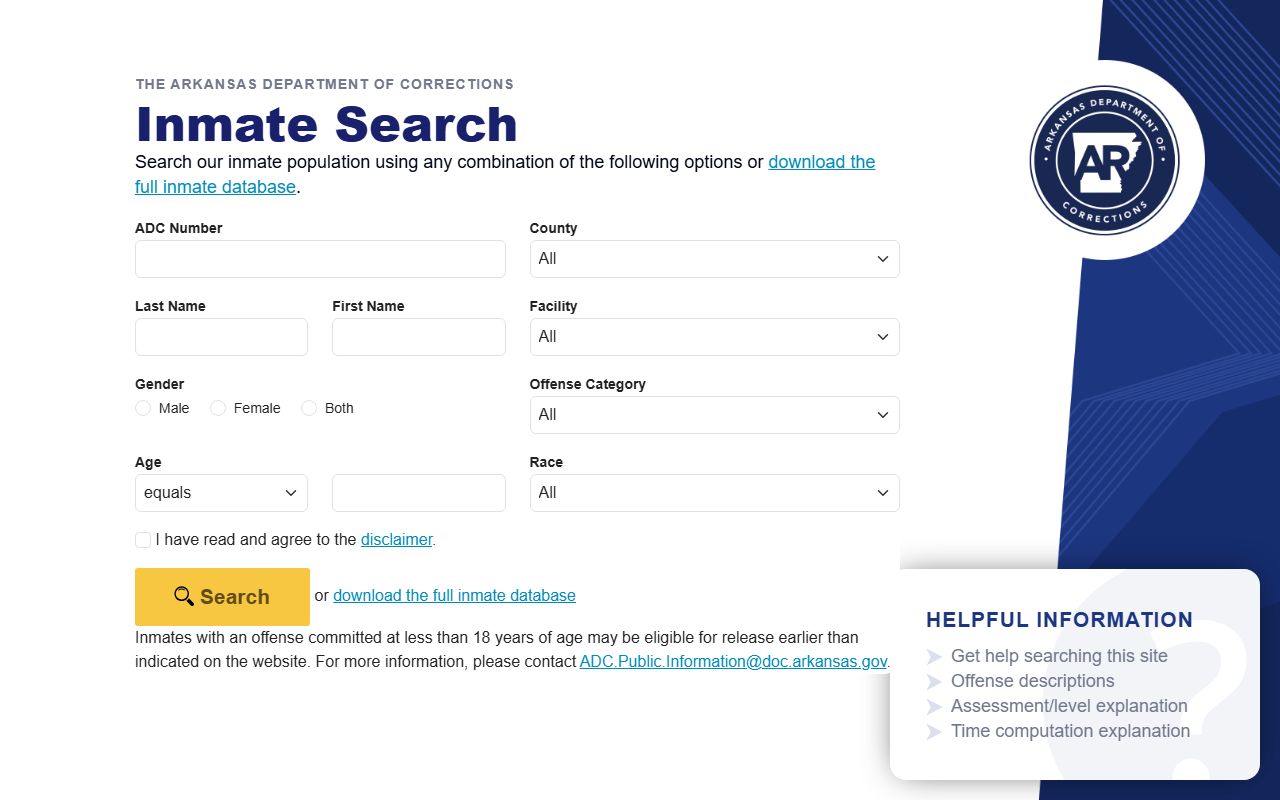
Public ADC records may show the inmate's name, race, date of birth, date of incarceration, a summary of offenses, and the current facility. Some records include mugshots and known aliases. ADC contact: 6814 Princeton Pike, Pine Bluff, AR 71602-9411. Questions go to adc.inmate.info@arkansas.gov.
Data can change by the hour. A release, a transfer, or a new booking won't always show the same minute. If you need a certified status, call the facility. For a pretrial inmate at the county level, start with the county sheriff jail roster, then go to ADC once the person is moved.
Arkansas Sex Offender Registry
The Arkansas Sex Offender Registry is run by ACIC and is a separate tool from general arrest history. You can search by address, city, county, ZIP, or name. The map view shows level 3 and level 4 offenders near an address. Levels 1 and 2 are not posted publicly. Around 1,624 level 1 and level 2 offenders are in the system but do not show up on the public map.
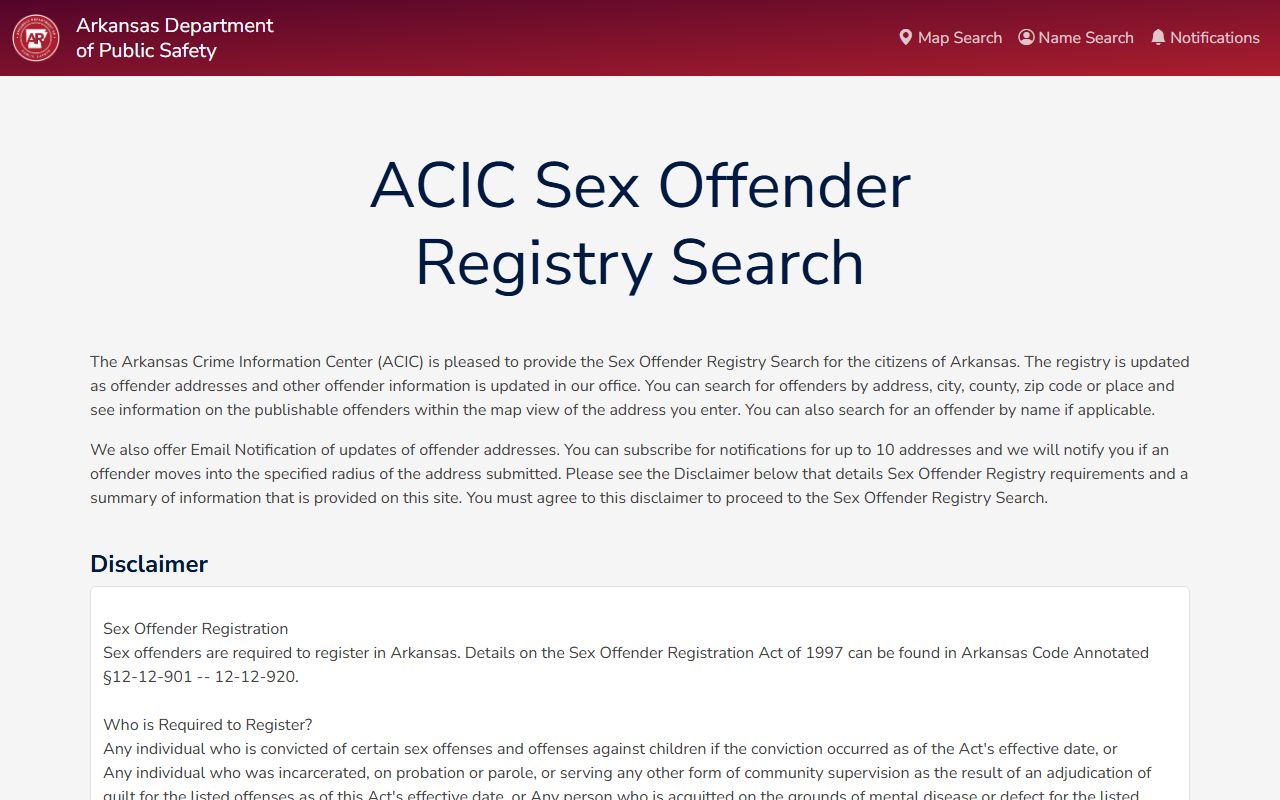
Under Ark. Code Ann. § 12-12-903, Arkansas uses four risk levels. Level 1 is the lowest. Level 4 is the highest and is described as a sexually violent predator. Level 1, 2, and 3 offenders must re-register every six months. Level 4 offenders re-register every three months. Thousands of non-mappable offenders, whose addresses aren't recognized by the mapping tool, also exist in the registry.
VINE Program for Arkansas Arrest Updates
VINE stands for Victim Information and Notification Everyday. It's a free hotline and website at vinelink.com. ACIC runs the Arkansas side. The system tracks custody status of offenders in the Arkansas Department of Correction, the Arkansas State Hospital, and county jails statewide. It also pushes court event data entered by prosecuting attorneys.
Call 1-800-510-0415 or sign up online. Victims can register for notifications on custody, parole, or court events. The program uses a four-digit PIN to confirm the victim when a call goes out. Registrations are anonymous and are protected from FOIA. Juvenile info is not released through VINE unless the juvenile is charged as an adult. Press 0 on the hotline to reach a live operator 24/7.
FOIA Rules for Arkansas Arrest Records
The Arkansas Freedom of Information Act, at Ark. Code Ann. § 25-19-101 et seq., is the bedrock statute for records access. It says public records shall be open to inspection and copying by any Arkansas citizen during business hours. Agencies have three business days to respond. Fees cannot be more than the actual reproduction cost. Agencies must itemize charges if you ask.
Requesters must be Arkansas citizens, but not incarcerated felons. Arrest records, booking sheets, jail rosters, and warrant data are generally open. Ongoing investigation files are not. Juvenile records are not. Sealed arrest and conviction records are not, per Ark. Code Ann. § 16-90-1401 et seq., the Comprehensive Criminal Record Sealing Act of 2013. Records exempt from FOIA also include undercover officer identities, personnel files, and personal details of minors under Ark. Code Ann. § 9-27-309. The Arkansas Attorney General publishes the FOIA Handbook and opinions, including 2003-057 and 2003-183, on sealed record access. The Attorney General sits at 323 Center Street, Little Rock, 501-682-2007.
Criminal history reporting standards are in Ark. Code Ann. § 12-12-1001 et seq. That chapter makes ACIC the central repository. It defines what counts as criminal history information. It also requires fingerprinting at arrest for specified offenses and sets up the disposition reporting rules for all criminal justice agencies.
Sealing Arkansas Arrest Records
Arkansas uses the word "seal" where many states say "expunge." The Comprehensive Criminal Record Sealing Act of 2013 is the framework. You file a petition in the court where the case was heard. Misdemeanors and many felony convictions can be sealed after you finish your sentence and wait the required time. Serious violent felonies, sex offenses that require registration, public sexual indecency, indecent exposure, and exposing another person to HIV are not eligible.
A sealed record is taken out of the public view. ARCH will not return it. CBC will not return it. The record stays with the court and with law enforcement for limited uses. Juvenile record sealing uses its own statute, Ark. Code Ann. § 9-27-309. For help with the petition, most counties link to standardized forms through the Administrative Office of the Courts at arcourts.gov.
Administrative Office of Arkansas Courts
The Arkansas Administrative Office of the Courts oversees day-to-day operations across the state court system. Director Marty Sullivan runs the office at 625 Marshall Street in Little Rock. The number is 501-682-9400. The site holds a court directory, publications on the court system, and resources for understanding how criminal cases move from filing to disposition.
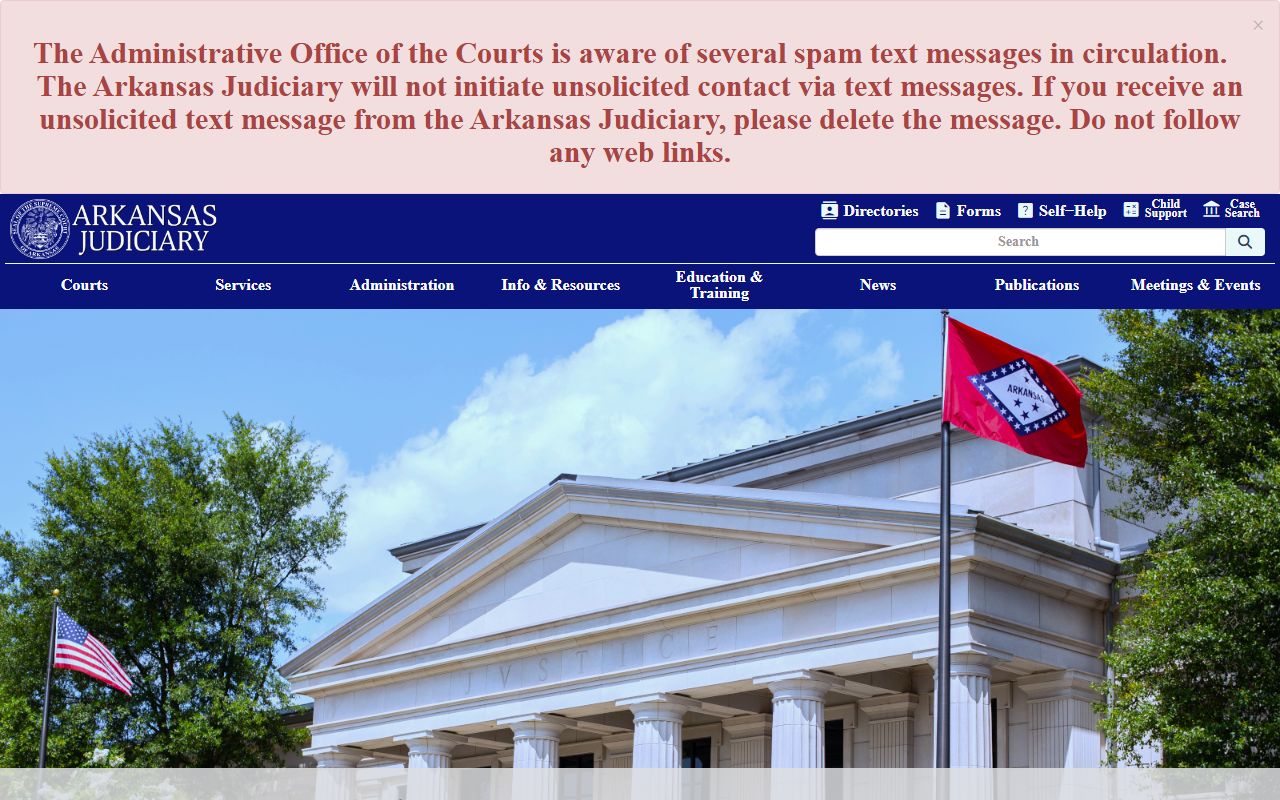
CourtConnect is the AOC's flagship public search tool. eTraffic handles traffic ticket payments in jurisdictions that use Contexte. Electronic filing systems are being rolled out across Arkansas courts. Circuit Courts hear felony cases. District Courts handle misdemeanors, preliminary hearings, and city ordinance violations. The Arkansas Supreme Court and Court of Appeals sit above both for appeals.
Note: Different courts handle different parts of the arrest-to-conviction path. District courts see the first appearance. Circuit courts handle the felony trial and plea work.
County Jails and Arrest Records in Arkansas
Most arrest records start at the county jail. Arkansas has 75 county sheriffs, plus city police departments, and each maintains its own roster. Some counties run slick real-time portals. Others post a weekly arrest report. A handful still do phone-only lookups. Larger counties like Pulaski, Benton, Washington, Faulkner, Saline, and Sebastian push booking data within hours.
The Pulaski County Regional Detention Facility at 3201 West Roosevelt Road in Little Rock houses more than 1,200 detainees on a daily basis. It opened in 1994 and is the largest county lockup in the state. Pulaski's roster is online at pulaskijail.com. Benton County's sheriff runs a real-time roster at sheriff.bentoncountyar.gov. Washington County's roster is at washcosoar.gov with a three-day intake list too.
Several counties use the ISOMS portal platform, which shows name, age, class, race/sex, intake date, city, arresting department, and bond. Columbia, Cleburne, Ouachita, and Scott counties run ISOMS. Other counties use 365Labs (Grant), myr2m (Craighead and Johnson), or InteropWeb (Monroe). For counties without a web portal, the Arkansas Sheriffs' Association page often serves as a landing spot.
The Arkansas Sheriffs' Association at arkansassheriffsassociation.com lists contact info and jail addresses for all 75 counties. It's a useful backup when a county site is down. Third-party aggregators mirror some of this data, though official sheriff portals are the better source.
What's in an Arkansas Arrest Record
A typical Arkansas arrest record holds the arrest date and time, the arresting agency, the charges, a mugshot, the booking number, the bond amount, and the release date if the person is out. Many county rosters also show gender, race, age, height, weight, and the arresting officer. Charges carry statute citations so you can look up the actual law. Classes show up as misdemeanor, felony, or specific custody tiers like "IV-Maximum Custody" on ISOMS sites.
Under the Greene County sheriff's format, records typically include date, time, and location of arrest, the arrestee's personal information, mugshot and fingerprints, a short description of the alleged offense, the charges filed, the classification (felony, misdemeanor, or infraction), and the court hearing date and location. That template lines up with what most of the 75 counties post.
Some data is held back. Undisclosed investigations, documents restricted by court order, personnel records, undercover officer identities, personal details of minors, and medical or adoption records are all exempt. Active warrants are often pulled from public view to avoid tipping off a wanted subject, though many counties do post warrant lists.
Browse Arkansas Arrest Records by County
Each of the 75 counties has its own sheriff, detention center, and arrest record workflow. Pick a county below to find the local jail roster, warrant search, and FOIA contact.
Arrest Records in Major Arkansas Cities
City police forces keep their own arrest reports and share bookings with the county jail. Pick a city to find the department's records unit and FOIA process.